microneedling Dublin
Microneedling in Dublin: what it actually does for your skin


Microneedling in Dublin is one of the most misunderstood treatments in aesthetics. Patients often arrive thinking it's either a glorified facial or something a home roller off the internet can do just as well. It's neither. Done properly, it's a genuine skin-remodelling treatment that works by getting your own body to rebuild collagen where it has thinned out — and the gap between doing it properly and doing it badly is wider than almost anything else we offer.
What microneedling actually does
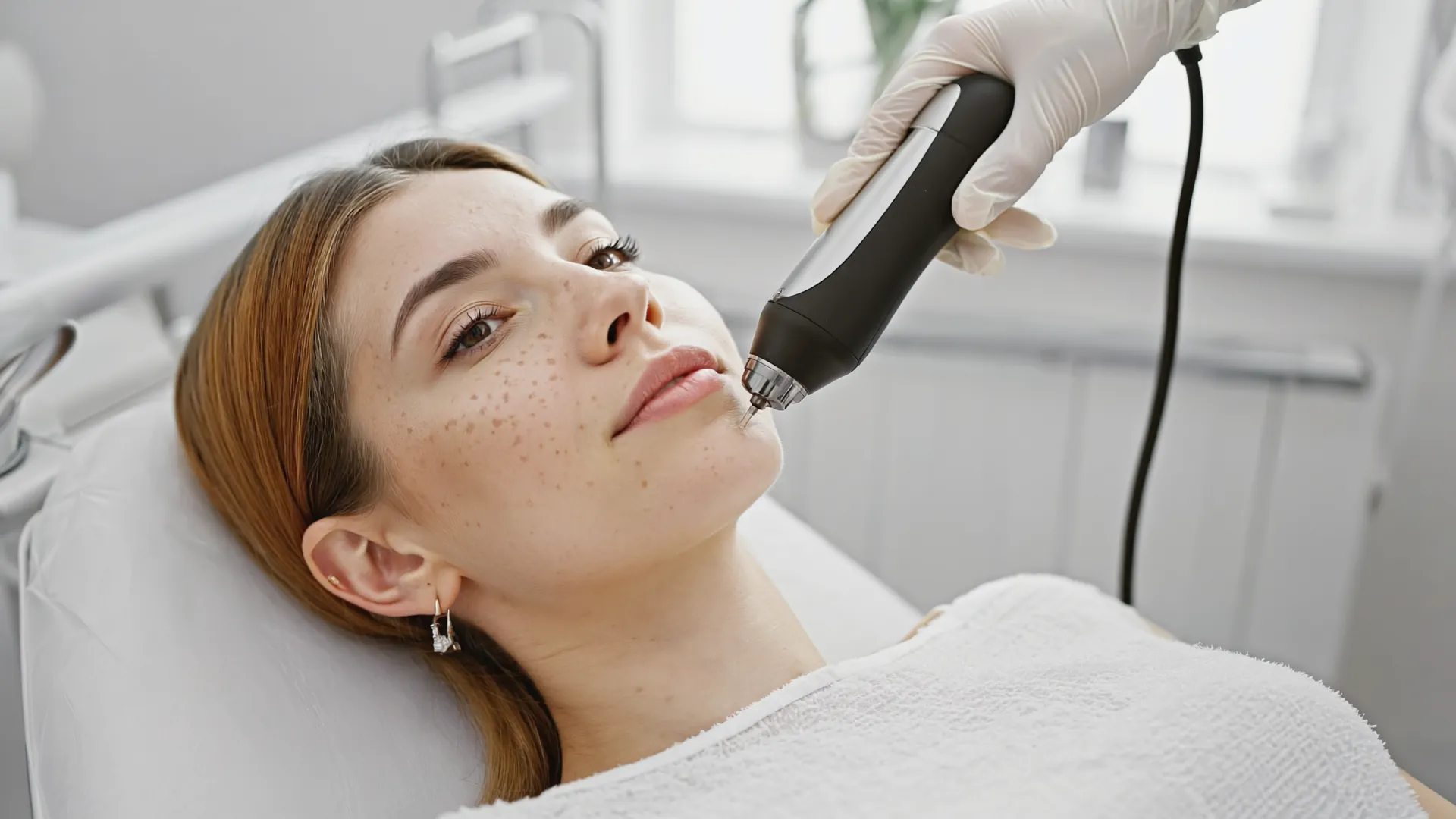
The principle is simple. A device with very fine needles creates thousands of tiny, controlled channels in the skin. These aren't wounds in the way you'd think of a cut — they're microscopic, and they close over quickly. But your skin doesn't know that. It reads them as damage and switches on its repair machinery: new collagen, new elastin, a fresh cycle of skin renewal in the exact area we've treated.
That's the whole point. We're not injecting anything to fill or freeze. We're prompting your skin to do what it did easily in your twenties and does more reluctantly with each passing decade. That's why it works so well for skin quality — texture, fine lines, enlarged pores, dullness, and scarring — rather than for volume or deep folds, which are a different job entirely.

Why the device matters more than the word
"Microneedling" on a price list tells you very little, because it covers a huge range. At one end is a dermaroller — a handheld wheel of needles you can buy online for the price of a coffee. At the other is a precision medical device with adjustable needle depth, sterile single-use tips, and in some cases radiofrequency energy delivered through the needles themselves. These produce very different results, and only one of them belongs anywhere near your face.
The problem with cheap rollers, home devices and untrained hands is control. Depth matters enormously — too shallow and you achieve nothing, too deep or too aggressive and you risk marking the skin you were trying to improve. In a proper clinic, needle depth is chosen for the area and the concern, the skin is prepared and cleaned to a medical standard, and the person holding the device understands the anatomy under it. That's what you're paying for, and it's why results from a serious clinic look nothing like the disappointment people report from a home kit.
RF microneedling: going deeper, on purpose
The version we lean on most at Amara is radiofrequency microneedling — at our clinic that's the EXION platform. It combines the needling with radiofrequency energy released at a controlled depth in the skin. In plain terms, the needles create the channels, and the RF energy adds a measured amount of heat into the deeper layer of the skin where collagen actually lives.
That heat is what makes the difference for anyone whose real concern is early laxity — skin that's starting to look a little loose or crêpey rather than simply uneven. Standard microneedling remodels the surface beautifully; RF microneedling reaches the level where mild tightening happens too. For the right patient it's a meaningfully stronger result from the same appointment, without adding a single needle of filler.
Is this the same as Morpheus8?
If you have been researching RF microneedling, you will have met the name Morpheus8. It is one specific branded RF microneedling device; at Amara we use a different platform, EXION. Both work on the same principle — fine needles creating controlled channels while radiofrequency energy heats the deeper layers where collagen lives — and both are used for tightening, texture and acne scarring, though as with any device, results vary with skin type and the number of sessions. We are not a Morpheus8 provider, and I have no interest in pretending otherwise.
In my experience, the difference that matters most to your result is less about which brand of device is in the room and more about who is holding it. The needle depth and energy settings that suit your skin are a clinical decision — at Amara I set those personally at your consultation rather than working from a fixed protocol. If you are weighing up RF microneedling options, that comparison is exactly the conversation worth having.
Where exosomes come in
Because microneedling opens those temporary channels, it also gives us a window to deliver active ingredients into the skin rather than just onto it. One option we sometimes pair with a treatment is exosomes — signalling particles thought to support the skin's own repair and recovery process after the needling. Think of the microneedling as doing the remodelling work, and the exosomes as helping the skin recover and respond more comfortably afterwards.
I'll be honest with you here, because it's an area full of marketing noise: exosomes are a newer, evolving part of the field, and I treat them as a supportive add-on for suitable patients rather than a miracle in a vial. Whether they're right for you is exactly the kind of thing we'd talk through at a consultation, not something to decide from an ad.
Who it suits — and who should wait
The patients this serves best are the ones whose complaint is skin quality rather than volume: acne scarring, enlarged pores, early fine lines, dullness, and skin that is starting to feel less firm. It works on the face, neck and décolletage — anywhere the aim is to rebuild the skin's own structure rather than add to it.
It is honest to say who should wait, too. If your skin is in an active breakout, if there is an active skin infection in the area, or if you are pregnant, microneedling is not the right starting point — and I would rather tell you that here than take a booking I should not take. It rarely means nothing can be done; it means the first step is a different one, and working that out is what a consultation is for.
What results to actually expect
This is where honesty saves everyone disappointment. Microneedling is not a one-and-done treatment, and it is not instant. You're relying on your body to build new collagen, and collagen takes weeks. Most people see the real change over the two to three months after a course of sessions, not on the drive home. What you can realistically expect is smoother texture, refined pores, softer fine lines and a brighter, healthier-looking surface — a gradual improvement in skin quality rather than a dramatic overnight transformation.
- It builds your own collagen — nothing is injected to fill or freeze
- Best for texture, fine lines, pores, dullness and scarring — not for volume
- It works as a course, with results building over the following months
- RF microneedling adds controlled heat for mild tightening as well as texture
- Results vary from person to person, which is exactly why the consultation matters
On timing: you may notice some freshness within the first few days, but the collagen remodelling is gradual — the full effect of a session builds over roughly four to six weeks, which is why sessions are spaced rather than stacked. How long the overall result holds depends on your skin, age and lifestyle; results can hold for six to twelve months, and a maintenance session can extend that. It is a plan to make together at your consultation rather than a promise from a paragraph.
Is it good for acne scarring?
This is one of the treatments I'm genuinely enthusiastic about for acne scarring, because it addresses the actual cause. Rolling and boxcar scars are places where the skin has lost structure underneath. By stimulating fresh collagen precisely in those areas, microneedling — and especially RF microneedling — can gradually soften and rebuild that lost support. It rarely erases scarring completely, and I'd be wary of anyone who promises it will, but the improvement over a course is often the most rewarding result we see with this treatment.
What microneedling costs in Dublin
Price is the question most people want answered before they ring a clinic, so here it is plainly. At Amara, RF microneedling starts at €350 for the face. Face and neck together is €450, and there is a face, neck and décolletage option beyond that. If we pair the treatment with exosomes, it is €600 for one area and €700 for two.
Two things are worth saying about those numbers. First, for most concerns this works as a course rather than a single visit, so the figure that actually matters is the plan — and I would rather set out a realistic one at the consultation than sell you sessions you don't need. Second, if you're comparing prices around Dublin, compare the treatment rather than the word. A short "microneedling facial" with a cosmetic pen and a course of radiofrequency microneedling on a medical platform sit at very different prices because they are doing very different amounts of work.
One more option worth knowing about: we also offer a needle-free radiofrequency treatment, from €250 a session. It is the choice when you want surface glow and freshness without needles; the microneedling version is the deeper, collagen-remodelling treatment. Which of the two suits you is a consultation question rather than a price-list decision.
What the appointment is like
We numb the skin first with a topical cream, so the treatment itself is very tolerable — most people describe it as a mild prickling or warmth rather than pain. Afterwards you'll look a little flushed for a day or so, and occasionally there's slight roughness as the skin settles. It's a treatment you can generally fit around normal life with a bit of planning. We'll always send you home knowing exactly how to look after your skin for the next few days, because good aftercare protects the result you've paid for.
Preparing for it — and recovering after
Before the appointment, the main things to avoid are sun exposure, tanning beds and active skincare such as retinoids for a few days. Our team will give you the full pre-treatment instructions at your consultation, so nothing rests on memory.
Afterwards, expect redness and a feeling of tightness for a day or two, similar to mild sunburn, with most people back to their normal routine the next day. How you look after the skin in those first days matters to the result, which is why we send every patient home with exact aftercare instructions.
Where to have microneedling in Dublin
Amara is at 1 Fitzwilliam Street Upper, Dublin 2, open Monday to Saturday. If you are comparing clinics, my advice is to look past the price list to who is actually holding the device: this is a medical treatment, and the depth, energy and plan should be set by the person accountable for your outcome. That is how we work here — and if a VISIA skin assessment would help you see where your skin actually stands before deciding, it is free, and it gives us a baseline to measure your results against over time.
Common questions
How many sessions will I need?
It depends on your skin and your goal — someone maintaining good skin needs far less than someone rebuilding acne scarring. As a guide, most people do best with somewhere between three and six sessions, spaced four to six weeks apart — some need fewer — and we'll set out a realistic plan at the consultation rather than selling you sessions you don't need.
Is microneedling better than filler or skin boosters?
It's not better or worse — it's a different tool. Filler adds volume, skin boosters and bioremodelling hydrate and improve quality from within, and microneedling remodels texture and stimulates your own collagen. The right answer is often a combination, sequenced sensibly, which is a plan best made in person.
How long does a microneedling appointment take?
Allow roughly half an hour of numbing first, then the treatment itself: about 30 minutes for the face, 45 minutes for face and neck, and an hour if we are treating face, neck and décolletage together. It is a lunchtime-length appointment rather than a half-day.
Should I have microneedling or a HydraFacial?
They answer different questions. A HydraFacial cleanses, exfoliates and hydrates the surface — it is the treatment for a bright, fresh, well-kept complexion, and it has no real downtime. Microneedling works underneath, prompting new collagen over months to change texture and acne scarring. If your skin looks dull, start with the facial. If the structure of the skin is the problem, needling is the tool. Plenty of people end up doing both, spaced sensibly. If you are weighing the two, I have written a plain guide to what a Hydrafacial in Dublin actually involves, including what each of the three tiers costs.
Can I just use a home microneedling roller instead?
I'd strongly advise against it. Home rollers can't control depth or sterility, and the most common outcomes I see from them are irritation and, occasionally, marking. If it's worth doing to your face, it's worth doing with a medical device and trained hands.
Related at Amara
- RF Microneedling at Amara — prices and booking
- Skin Boosters vs Polynucleotides vs Filler
- Profhilo bioremodelling: hydration and glow explained
- What causes facial sagging after 40, and how to lift it
About Dr Paul
 I'm Dr Paul Munsanje — a medical doctor with over 17 years in aesthetic medicine, running a doctor-led clinic across Dublin, Warsaw and Marbella. My work is built on facial anatomy, precision and restraint: treating where it genuinely helps, and just as readily talking you out of what you don't need. This journal is where I write down honestly what I tell my patients.
Consultation-first · Dublin · Warsaw · Marbella
Want my read on your face?
Start with a consultation and I’ll give you an honest, unhurried assessment — and tell you if a treatment isn’t worth it.
Start a consultation with Dr Paul →