facial sagging after 40
What causes facial sagging after 40, and how to lift it


By the time we hit our forties or fifties, most of us start to notice a certain heaviness in the face – not just lines, but a downward pull that wasn't there before. If surgery isn't your thing, and for most of my patients it isn't, there's a layered, non-surgical approach I turn to instead: bone, soft tissue, muscle, and skin quality – treated as four separate problems, not one.
Why the face falls before it wrinkles
Sagging isn't really about the skin stretching, at least not at first. It's about structure, and it happens in more than one place at once. We lose fat in specific pockets of the face — the hollow that appears under the eye is usually the first one anyone notices in the mirror. The skin loses laxity and tension. The bone itself changes shape – the skull isn't static, it slowly loses volume in places as we age. And the muscles that hold everything up, particularly around the neck, change how they work. All of it adds up to drooping, and how much depends entirely on your own starting anatomy. None of this is one problem with one fix – it's four, and I treat them separately.
Layer one: restoring lost bone with structural filler
The first layer most people never think about is the skull. Where the bone has lost volume – often at the cheekbone or along the jaw – I use a thicker, firmer filler placed deep, directly on the bone, to rebuild that structural support. A proficient injector doesn't just fill lines – they use the skull itself as a map, finding the points of leverage that give a genuine lift rather than just plumping the area that looks tired. This is the foundation everything else sits on top of.

Layer two: the three-point lift with soft tissue filler
Once the deeper structure is addressed, I use a softer filler placed more superficially to replicate the soft tissue that's been lost – I call this the three-point lift. I place it at three specific points:
- Laterally on the cheekbone, at the side of the face
- Laterally on the mandible, along the jawbone
- In the mid-face
By restoring width and support at those two lateral points, then adding volume at the mid-face point, we can pull the tissue on top back to where it used to sit – rather than simply softening a fold. It's a small number of points doing a lot of structural work, which is why I'd rather do this than chase every line with product. I generally reach for a Juvederm filler here because I know exactly how it behaves once it's under the skin.

Layer three: relaxing the muscles that pull you down
The third layer is muscular, and it works in the opposite direction to what most people expect. On the face there are a number of muscles that are constantly pulling down – we call them depressors. We have depressors around the eyes, depressors at the side of the mouth, and depressors in the neck. When I treat these depressors with anti-wrinkle muscle-relaxing injections, I can ease that downward pull and get a lift at a few different points on the face, without adding a drop of filler. The one muscle I am careful not to over-weaken here is the masseter: too much jaw slimming takes away lower-face support and can read as premature jowling, which is the opposite of a lift.

EMFACE: strengthening the muscles that lift you up
Just as depressor muscles pull the face down, we have elevator muscles whose job is to lift it back up. In clinic I use a machine called EMFACE, which stimulates those elevator muscles directly and makes them stronger over a course of sessions. I use EMFACE across the forehead, on the cheeks, on the neck and under the eyes, wherever the underlying muscle needs to be doing more work to hold everything up. It's the one part of this approach that isn't about adding anything or relaxing anything – it's about training what's already there.
Layer four: rebuilding collagen at depth
The last layer works underneath the skin's surface, in the soft tissue and collagen itself. I use RF microneedling – radiofrequency energy delivered through fine needles into the deeper layers of the skin – to stimulate the body's own production of collagen and elastin. Unlike the other layers, this isn't about adding volume or moving tissue directly; it's about improving the quality and density of what's already there, which over a course of sessions gives a genuine tightening and re-volumising effect from within. It's a slower layer than filler or EMFACE, but it's the one that keeps working in the background for months after treatment.
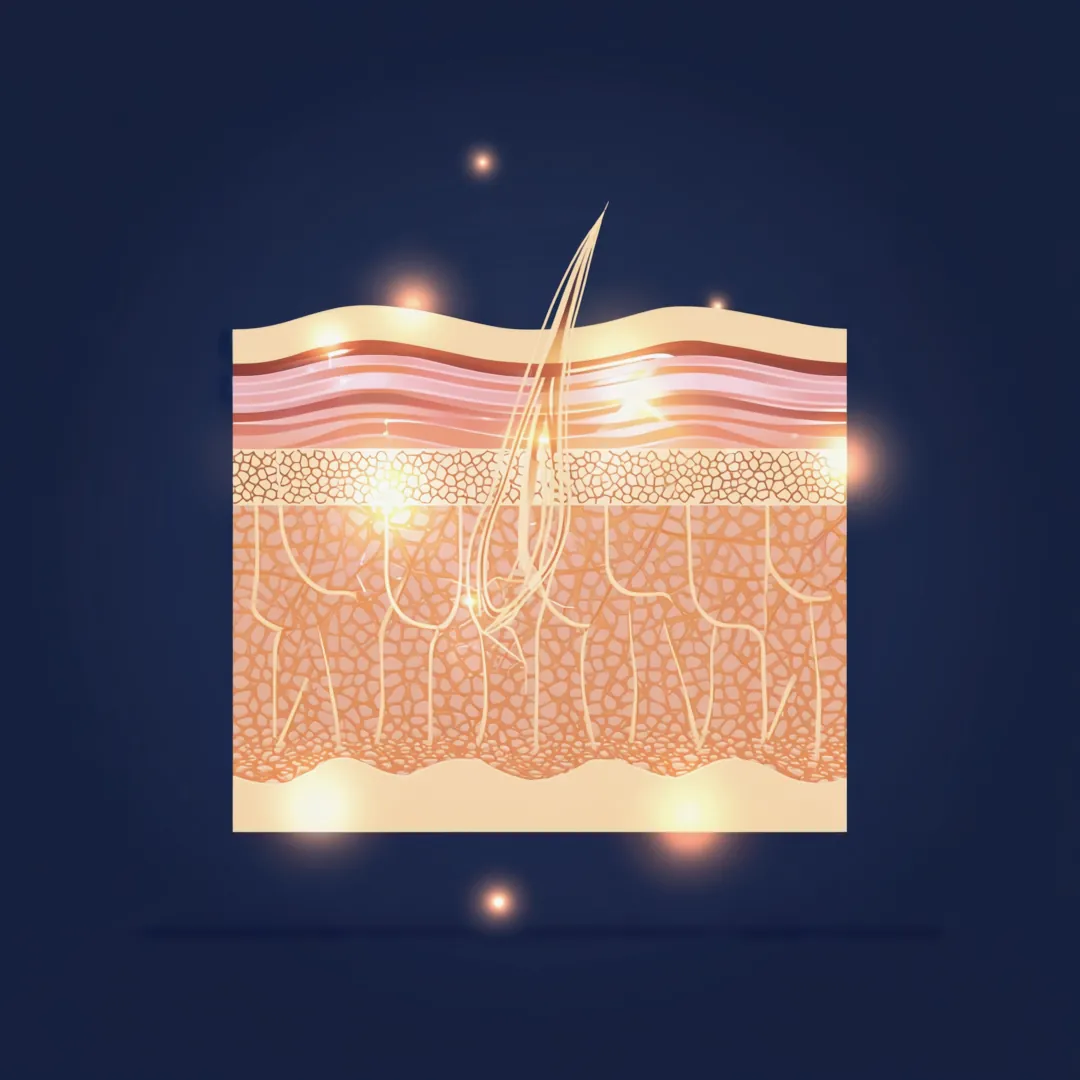
Skin quality is part of the picture too
None of this happens in isolation from the skin itself. Skin quality feeds directly into how much sagging you actually see. Two people can have almost identical bone structure and muscle tone, but if one has looser, less elastic skin, they will show more visible sagging than the other. That's why I never treat sagging as a single problem with a single fix – bone, soft tissue, muscle, RF microneedling and skin quality all play a part, and which combination matters depends on what's actually happening in your face.
When does surgery actually make sense?
I get asked this a lot, so I'll be straightforward about it. If someone has let their face significantly drop over many years with no prevention at all, a facelift with an experienced surgeon can do things a non-surgical approach genuinely can't – and for that person, at that stage, it may well be the better option. But a facelift after the face has already fallen is a bigger undertaking than most people expect: real recovery time, weeks before results fully settle, and a meaningful cost if you want it done well. My honest view is that most people don't need to get there in the first place. The patients I see wanting to start in their thirties, forties, fifties or sixties are almost always better served by staying ahead of it – bone, soft tissue, muscle and skin quality, addressed early and maintained – than by waiting for a problem surgery then has to solve. Skincare and a good moisturiser alone won't do that job; it takes the layered approach above.
Common questions
Do I need all four layers, or just one of them?
It depends entirely on what's causing your sagging. Some patients need bone or soft-tissue volume restored, some need their depressor muscles calmed, some need their elevator muscles strengthened, some need collagen rebuilt with RF microneedling, and many need a combination. That's exactly what a consultation is for – working out which layers are doing the most damage in your particular face, rather than defaulting to one treatment for everyone.
Is a three-point lift the same as a full-face filler treatment?
No. A three-point lift is a targeted, structural approach – using the skull as leverage at the cheekbone, the jawbone and the mid-face – rather than filling multiple areas across the whole face. The goal is to restore lost support and pull the tissue back up, not to add volume everywhere.
Can EMFACE or RF microneedling replace filler or anti-wrinkle injections?
Not exactly – each does a different job. EMFACE strengthens the elevator muscles that lift the face. RF microneedling rebuilds collagen at depth. Filler restores lost structural volume, and anti-wrinkle injections relax the depressor muscles pulling the face down. Most patients who want a real, visible lift benefit from more than one of these working together.
Is any of this permanent?
No non-surgical treatment is permanent, and results vary from person to person depending on anatomy, lifestyle and how the treatments are maintained over time. What a layered approach does is let you stay ahead of sagging for years, revisiting whichever layer needs topping up, rather than reaching for one big intervention only once it's already visible.
Not sure which layer applies to you?
The honest answer is almost always: it depends on your face. A consultation with me is where we actually look at your bone structure, your muscle tone and your skin quality together, and work out which of these four layers – if any – is doing the most to age your face right now. Book a consultation and we'll build the right combination for you, rather than starting from a generic plan.
Related at Amara
- Dermal filler
- Three-point lift
- EMFACE
- RF microneedling
- Nefertiti neck lift
- Profhilo
- Why some faces age 20 years slower: the ageing formula
About Dr Paul
 I'm Dr Paul Munsanje — a medical doctor with over 17 years in aesthetic medicine, running a doctor-led clinic across Dublin, Warsaw and Marbella. My work is built on facial anatomy, precision and restraint: treating where it genuinely helps, and just as readily talking you out of what you don't need. This journal is where I write down honestly what I tell my patients.
Consultation-first · Dublin · Warsaw · Marbella
Want my read on your face?
Start with a consultation and I’ll give you an honest, unhurried assessment — and tell you if a treatment isn’t worth it.
Start a consultation with Dr Paul →