tear trough filler Dublin
Tear Trough Filler Dublin: A Doctor's Honest Guide


If you're searching for under-eye or tear trough filler in Dublin, you're almost certainly tired of looking tired — the shadow under the eyes that concealer never quite fixes and a good night's sleep doesn't lift. Filler can be genuinely transformative here. It's also the single area of the face where the wrong decision shows the most, and lasts the longest.
This guide is deliberately honest. The under-eye is the most technical, highest-judgement place on the face to place filler — and for a real proportion of people, filler isn't the right answer at all. Our aim here is to help you understand what's actually causing your under-eye concern, whether filler will help it, and what a careful, doctor-led approach looks like at Amara.
First, what's actually causing your dark circles?
This is the question that decides everything, and it's the one most price lists skip straight past. “Dark circles” and “tired eyes” are a look, not a diagnosis, and they come from at least four different things — often in combination:
- A hollow (the tear trough). A genuine groove between the lower lid and the cheek casts a shadow. This is the one thing filler is designed to address.
- Pigment. Some under-eye darkness is melanin in the skin itself — often genetic, common in every skin tone. Filler does nothing for pigment; it can even make it look worse by drawing light differently.
- Thin, crepey skin. As the delicate lower-lid skin thins, the bluish tone of the vessels beneath shows through. That's a skin-quality problem, not a volume one.
- Puffiness (eye bags). Fat pads or fluid can make the under-eye protrude. Adding filler beneath a genuine bag usually makes it heavier, not fresher.
So the honest starting point isn't “how much filler” — it's which of these is yours. Get that wrong and even flawless injecting gives a disappointing result. Get it right and a very small amount can change the whole face.
What tear trough filler actually is
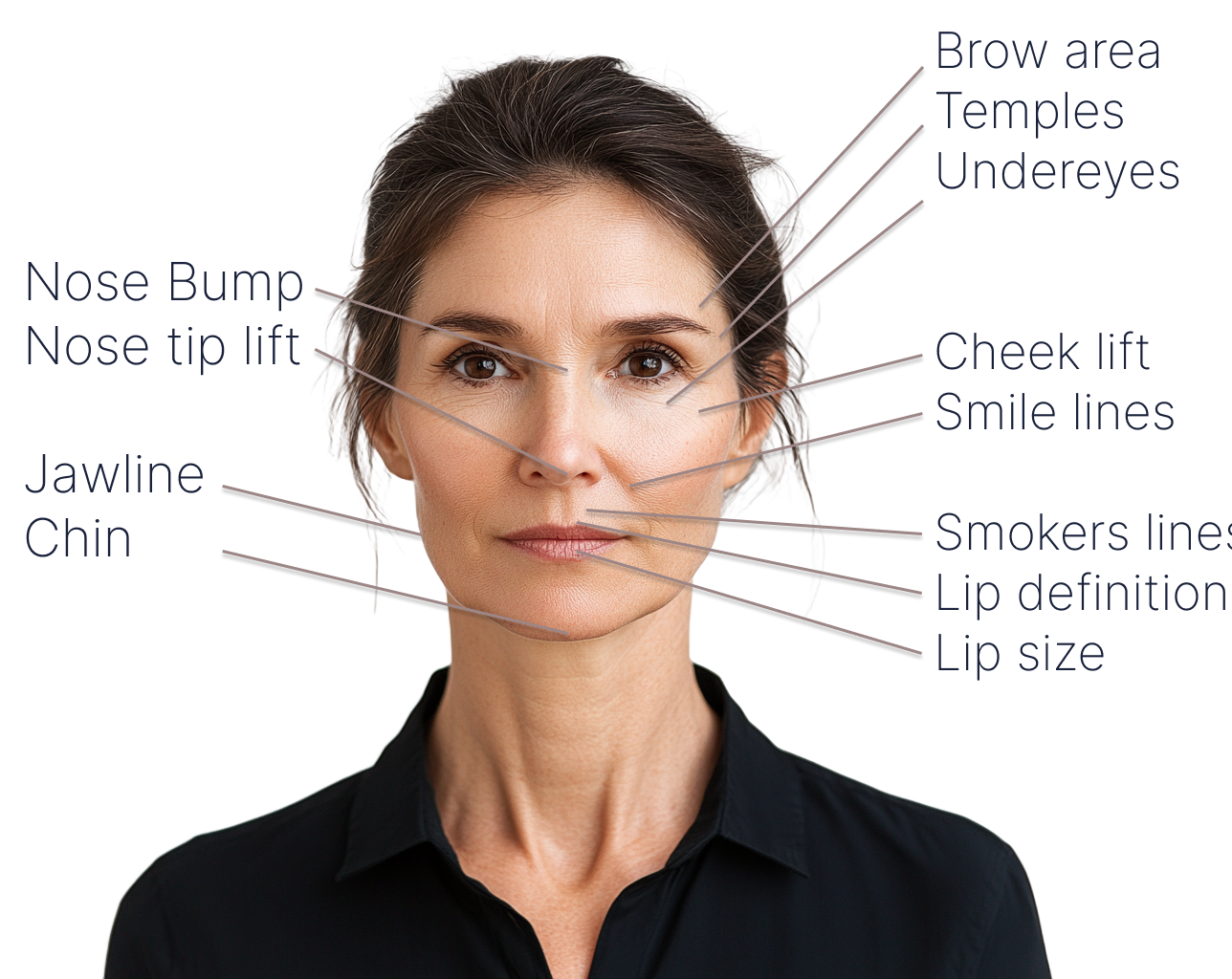
Tear trough filler is a hyaluronic-acid gel — the same family of temporary, dissolvable filler used elsewhere in the face — placed deep along the hollow where the lower eyelid meets the cheek. By gently restoring volume to that groove, it lifts the shadow that reads as darkness and tiredness. Because it's hyaluronic acid, two reassuring things are true: it's gradually broken down by your body over time, and it can usually be dissolved with an enzyme if the result isn't right for you. That safety net matters more here than anywhere else on the face.
What tear trough filler is not is a lot of product. This area holds a tiny amount — often a fraction of a syringe — and rewards restraint. The under-eye is unforgiving of excess: overfilling is the single most common reason under-eye work looks puffy, bluish or heavy.
Why the under-eye is the area to be careful with
Every reputable injector will tell you the tear trough is where skill and judgement matter most. A few reasons why:
- The margin for error is tiny. Millimetres and microlitres change the outcome. This is precision work, not a top-up.
- The wrong product misbehaves. A gel that's too thick, too superficial, or holds too much water can give a puffy look, or a faintly blue discolouration (the Tyndall effect), that lingers.
- It's an anatomically busy area. There are important blood vessels around the eye, and while serious complications are rare, they're serious enough that this is treatment we believe belongs in experienced medical hands — with a clear plan and honest consent about the risks.
None of this is meant to frighten you — done well, on the right candidate, tear trough filler is one of the most rewarding treatments there is. It's meant to explain why we assess so carefully before we ever recommend it, and why the cheapest option is rarely the place to economise on this particular area.
Who is — and isn't — a good candidate
The best results come from choosing the right people, not the right needle. In our experience, tear trough filler tends to suit someone with a true hollow and reasonably good skin quality, where the shadow is clearly coming from the groove itself. It tends not to suit someone whose main issue is genuine under-eye bags or fluid retention, significant puffiness, very lax or festooned skin, or darkness that's mostly pigment. In those cases, filler can make things look heavier or hold water, and a different approach gives a better, safer result.
This is where a doctor-led consultation earns its place. Part of what you're paying for is someone whose job on the day may be to talk you out of the treatment you came in asking for — because the honest answer is that it won't do what you hope.
The under-eye rewards the right decision more than the right technique. Half of good tear trough work is knowing when not to inject at all.
What we might recommend instead
If filler isn't right for your under-eye, that doesn't mean nothing can help — it means something more suitable will. Depending on what's actually driving the concern, we might suggest treatments aimed at skin quality rather than volume: skin boosters or polynucleotides to thicken and brighten thin lower-lid skin, for example, which address a different problem than filler does. For some people the right answer is a good eye-care routine and sun protection; for others, where there's genuine excess fat or skin, the honest conversation is that a surgical opinion — not filler — is the real solution. We'd always rather point you toward what will actually work than sell you what we happen to offer.

How under-eye filler works at Amara
Every under-eye journey with us starts with a consultation, not a treatment. We look closely at what's actually causing your concern — hollow, pigment, skin, or puffiness — assess your candidacy honestly, and only recommend tear trough filler when it's genuinely the right tool. When it is, we treat conservatively: a small, carefully placed amount, reviewed before we ever consider adding more. You can always build a little; an overfilled under-eye is a far harder thing to undo.
Amara is a doctor-led clinic in Dublin, and the under-eye is exactly the kind of treatment that reasoning is built for — careful assessment, an appropriate product, restraint, and the honesty to dissolve or decline when that's the right call.

What under-eye filler costs in Dublin
We don't publish a single flat price for tear trough filler, because a responsible price depends on what you actually need — and, just as importantly, on whether filler is right for you at all. What we can promise is transparency: after assessing your under-eye at consultation, we'll set out a clear, personalised plan and price before anything goes ahead, with no pressure to proceed on the day.
Common questions
Will tear trough filler get rid of my dark circles?
Only if the darkness is coming from a hollow casting a shadow. If it's mainly pigment or thin skin, filler won't fix it — which is exactly why we assess the cause first rather than assuming.
Does under-eye filler hurt?
Most people find it very manageable; numbing is used and the area settles over the following days. Some mild swelling or bruising in the first week is normal, and we talk you through exactly what to expect.
How long does it last?
As a general guide, tear trough filler often lasts up to around a year or longer, though it varies with the product, the amount and individual factors. Results vary from person to person.
Is it reversible?
Yes — because it's a hyaluronic-acid gel, it can usually be dissolved if you're unhappy or if it holds water. That safety net is one reason we favour hyaluronic filler in such a delicate area.
How do I book?
Start with a consultation — you can book online here, or read more about our approach to dermal filler. We'll give you an honest view of whether under-eye filler is right for you before anything is booked.
The under-eye is the area where the injector matters most, so it is worth reading what filler safety actually depends on before you book anywhere. If price is what is driving the decision, why cheap filler is a false economy explains what you are really paying for, and skin boosters versus polynucleotides covers the alternatives when volume is not the answer. Full details on our filler treatments, or start at the clinic homepage.
Consultation-first · Dublin · Warsaw · Marbella
Want my read on your face?
Start with a consultation and I’ll give you an honest, unhurried assessment — and tell you if a treatment isn’t worth it.
Start a consultation with Dr Paul →